
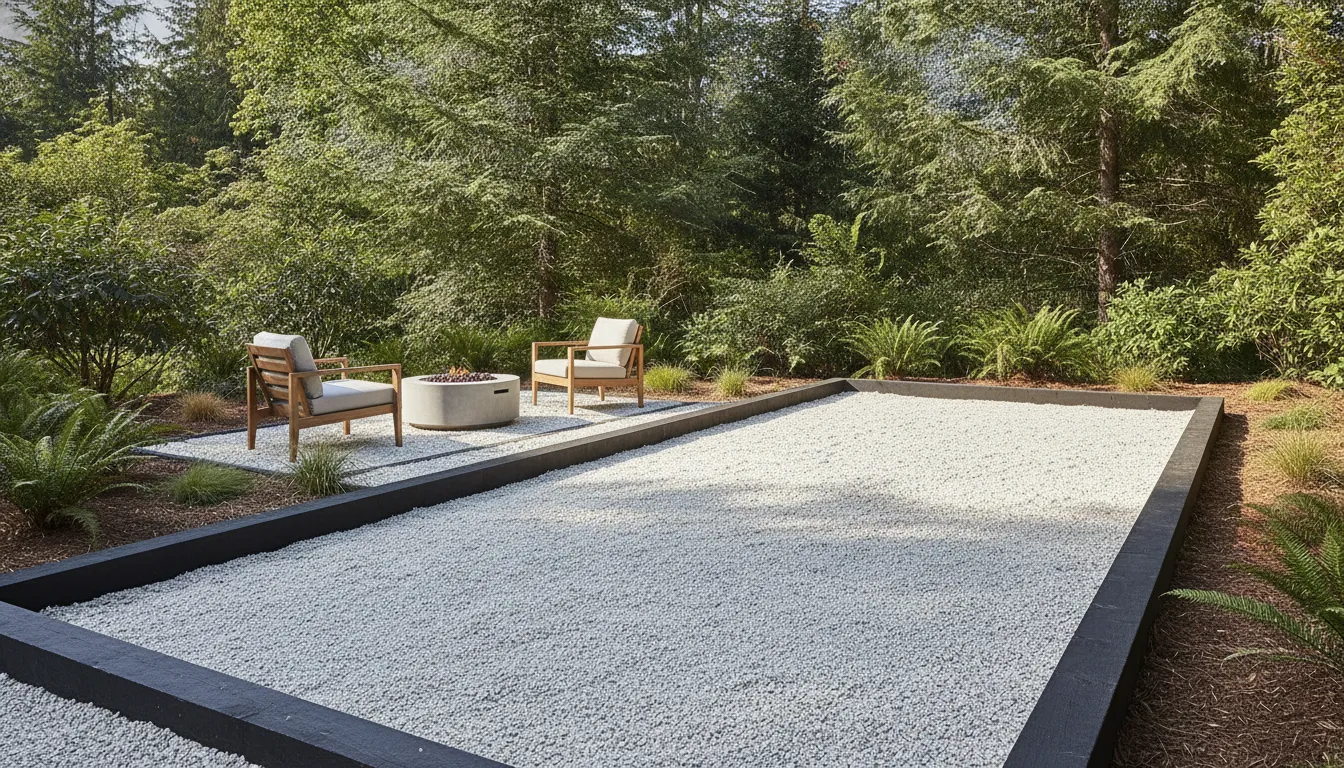
Planning an oyster shell bocce court involves more than spreading shell over a rectangle. The finished court depends on a suitable footprint, a stable base, drainage that fits the site, and enough material to create a consistent playing surface. In the Pacific Northwest, getting the moisture and compaction details right matters as much as choosing an attractive aggregate.
Contact ShellScapes about your bocce court project at (206) 565-5984.
An oyster shell bocce court uses crushed shell and shell flour to create a bright, compactable playing surface. As a planning guide, one cubic yard covers about 100 square feet at a 2 to 3 inch depth and weighs approximately 1,500 pounds. Exact quantities depend on court dimensions, base preparation, and site conditions.
The material choice shapes how the court feels under play, how water moves through it, and how the surrounding landscape comes together. Start by understanding why crushed oyster shell can work well as a court surface, then use that foundation to plan dimensions, quantities, drainage, installation, and upkeep.
Why an oyster shell bocce court works
Crushed oyster shell is a practical bocce surface because it can settle into a firm playing layer while still allowing water to move through it. The material is not simply a decorative topping. Its smaller particles help shape how the court compacts, drains, and looks within the surrounding landscape.
Shell flour helps create a stable surface
Shell flour is the fine portion of the crushed material. It binds shell fragments together and supports compaction and recalcification, producing a firm, sturdy surface when the court is installed and compacted appropriately. That combination gives the court more structure than a loose layer of coarse aggregate alone. Surface preparation, grading, and compaction still matter. Select and install the material as part of a complete court assembly rather than spreading it over an unprepared site.
Drainage and appearance suit outdoor play
ShellScapes describes crushed oyster shell as a well-draining material, an important consideration in the Pacific Northwest, where rain and persistent moisture can affect outdoor hardscapes. A surface that sheds or accepts water appropriately can help reduce standing-water problems associated with poorly planned courts. Site slope and the underlying drainage design remain decisive.
The aggregate also has a naturally sun-bleached white appearance. It creates a bright, relaxed court surface that can complement planting beds, gravel paths, stone, and other landscape elements. For a broader look at where the material fits beyond recreation areas, see these oyster shell landscaping applications.
A recycled material with a clear landscape role
ShellScapes sources its shell material from a local oyster-growing waste stream, giving a useful byproduct a second life in landscape construction. That recycled sourcing is part of the appeal, but the court still needs to be designed around play, drainage, access, and maintenance. The result is a surface chosen for both its material behavior and its relationship to the rest of the property, not just for its color.
How much crushed oyster shell for a bocce court?
Start with the finished playing area, not the truckload. Measure the court length and width, multiply those dimensions to get square footage, then compare that area with the planned surface depth. A standard example is a 60-by-12-foot court, or 720 square feet, but your project may be smaller or larger.
ShellScapes’ planning figure is about one cubic yard of crushed oyster shell for every 100 square feet at a 2- to 3-inch depth. That same cubic yard weighs approximately 1,500 pounds. Use those figures as a material estimate, then confirm the final quantity after the base, edging, finished grade, drainage, and delivery access have been evaluated. You can review the material details for crushed oyster shell aggregate before requesting project guidance.
| Playing area. | Planned depth. | Starting estimate. | Planning note. |
|---|---|---|---|
| 500 sq ft. | 2 to 3 inches. | About 5 cubic yards. | About 7,500 lb before site-specific adjustments. |
| 720 sq ft, 60 by 12 ft. | 2 to 3 inches | About 7.2 cubic yards. | About 10,800 lb before site-specific adjustments. |
| 1,000 sq ft. | 2 to 3 inches. | About 10 cubic yards. | About 15,000 lb before site-specific adjustments. |
How to use the estimate
The table applies the simple area rule: square footage divided by 100 equals an approximate cubic-yard count. It does not replace a takeoff. If the site needs additional material to account for uneven grades, settlement, transitions, or a separate base layer, the order may change. Conversely, a court with a different finished depth should be calculated separately rather than treated as a standard package.
For outside context only, some specialty suppliers describe roughly 1.5 to 3 inches as a blended court depth. Another industry source gives a broad 4- to 9-ton range depending on court size. Those are rule-of-thumb references, not ShellScapes specifications or an exact quote. Ask for a site-specific quantity once the court dimensions and installation approach are defined.
How should you plan the site, dimensions, and drainage?
Start with the entire setting, not only the rectangle where the balls will roll. A 60-by-12-foot court is a useful standard planning reference, but it is not a universal rule. Confirm that the space works with the home’s scale, property lines, walking routes, views, and the room players need around the court. A landscape-industry guide describes courts at this size and notes that a hard-packed surface can combine clay soil and oyster shell with a finer topping material. Review the cited court-planning reference for that general context.
Account for the perimeter and surrounding circulation
Plan the playing rectangle, perimeter, and access as one system. A defined edge can keep aggregate in place and create a clean transition to planting beds, paving, or lawn. Some courts use substantial stone or brick walls, while others use a simpler border. Choose the approach based on grade changes, drainage, maintenance access, and the desired landscape character rather than copying a single specification.
Leave room for players to move safely and retrieve balls. Consider where equipment, seating, lighting, and service access will go. Shade can improve comfort, but trees and structures should be evaluated for roots, falling debris, and seasonal moisture. Trellises and outdoor lighting are optional features that can make the court more usable without making them requirements.
Resolve grade and rain before choosing the surface
In the Pacific Northwest, observe how water moves across the property during heavy rain. Avoid directing roof runoff or hillside flow into the court. A gently managed grade, stable base, and appropriate edge treatment can help, but surface aggregate alone cannot correct a wet or poorly draining site. On a very wet location or at the bottom of a slope, a perforated pipe within a drain-rock layer may be considered, as described in this general oyster shell court construction guide.
Drainage, excavation, base thickness, and perimeter construction should be assessed on site. For help matching the court to the property, see ShellScapes bocce court design and build. A site-specific review is the responsible way to determine which construction details are appropriate.
How to build an oyster shell bocce court step by step
A successful court depends on more than spreading shell over the ground. The site needs a stable perimeter, a base that manages water, and a surface that can be compacted without creating low spots. The sequence below is general planning guidance, not a substitute for a site assessment. In particular, excavation, grading, drainage, and material handling may require professional equipment and construction experience.
- Confirm the layout and finished elevations. Mark the court footprint, playing direction, access route, and surrounding clearances. Check how rainwater moves across the property and where the finished court will sit relative to patios, paths, structures, and existing grades. A level-looking layout can still need careful drainage planning in a wet Pacific Northwest site.
- Prepare and excavate the area. Remove vegetation, organic soil, roots, and unstable material from the court footprint. If the perimeter will be partly or fully set into the ground, excavate to accommodate the perimeter material and planned base layers. Keep the work area safe, and have underground utilities located before digging.
- Build the perimeter. Install a straight, square perimeter that will contain the aggregate and provide a consistent finished edge. A published oyster-shell court guide uses ground-contact-rated pressure-treated timbers as one perimeter approach, but the right material and dimensions depend on the site, local conditions, and design. Anchor or join the corners securely, then recheck the diagonals and elevations.
- Establish drainage and the base. Shape the excavated area so water does not collect beneath the playing surface. Install and compact the specified base or drain-rock layers in lifts appropriate to the project. For a very wet area or a court at the bottom of a slope, perforated pipe may be considered within the drain-rock layer. A professional should determine the drainage design where grades or runoff are complex.
- Place the oyster shell surface material. Spread the shell evenly to the planned depth rather than creating a thin center and deep edges. Shell flour can bind shell fragments and support compaction and recalcification into a firm, sturdy surface. ShellScapes notes that one cubic yard covers about 100 square feet at a 2 to 3 inch depth. So use the actual measured area and approved depth to plan material quantities.
- Wet and compact in stages. Lightly saturate the surface thoroughly enough to help the material settle, while avoiding erosion or standing water. Compact with suitable equipment, checking the surface as you go. After the court has been thoroughly saturated, compact it a second time. Recheck the grade, edges, and low spots rather than assuming additional passes will correct an uneven base.
- Finish and test the court. Dress the edges, remove loose debris, and verify that the surface is firm and reasonably consistent from end to end. Roll several balls through different lanes and observe movement, bounce, drainage, and any soft areas. Correct defects before adding surrounding landscaping or furniture. For site-specific design and construction decisions, review ShellScapes bocce court design and build.
For source context on perimeter preparation, drainage options, and the second compaction pass, see the published oyster shell court construction guide. Its sequence is useful for planning, but local soil, slope, rainfall, access, and permitting conditions should determine the final construction method.
Oyster shell vs. decomposed granite vs. sand for bocce courts
Material choice affects how a court responds to rain, rolling speed, foot traffic, and routine upkeep. In a wet Pacific Northwest landscape, drainage deserves as much attention as the way the surface feels under a bocce ball. ShellScapes describes crushed oyster shell as a well-draining surface, while a competitor comparison reports better drainage and faster ball movement than sand. That comparison is competitor-reported guidance, not a universal performance guarantee.
- Oyster shell: Crushed shell offers a bright, natural appearance and a surface that can become firm when the fine shell flour binds the fragments. ShellScapes describes shell flour as supporting compaction and recalcification into a firm, sturdy surface. The resulting feel can suit players who want a defined roll without the loose softness associated with an unbound surface. Drainage is a central advantage to evaluate on a rainy site, although the court still needs a properly planned base and grade.
- Decomposed granite: DG can provide a compactable mineral surface, but its performance depends on the selected gradation, fines, base preparation, and site drainage. It should be evaluated as a complete court system rather than assumed to behave the same way as oyster shell. For shell courts, one supplier recommends either oyster shell flour or a 3/8-inch blend for bocce. That is competitor-reported material guidance, not a ShellScapes specification or guarantee.
- Sand: Sand has a familiar, softer surface feel, but it may produce a different roll and require more attention to displacement after play and heavy rain. Bocce Boss reports that oyster shell provides faster ball movement and better drainage than sand. Again, treat those points as an outside comparison, then assess the actual court location, subgrade, and intended playing style.
For a Pacific Northwest property, compare the full installation plan: drainage route, edge restraint, compaction sequence, replenishment needs, and how the surface will look beside planting areas and paving. Browse these landscape and hardscape project ideas to consider how material character fits the broader setting, then choose the surface that supports both play and the surrounding landscape.
How do you maintain an oyster shell bocce court?
Routine attention helps preserve a consistent roll and keeps small drainage problems from becoming larger repairs. After heavy rain, walk the court and look for standing water, soft spots, washouts along the perimeter, or areas where shell has migrated. After play, scan for leaves, twigs, stones, and other debris that could affect footing or ball movement. A leaf rake or stiff broom can usually clear loose material without disturbing the surface unnecessarily.
Check level, drainage, and surface firmness
Use a straightedge or visual sightline to compare the court from end to end. Low areas may collect water, while raised or eroded edges can indicate runoff problems. In the Pacific Northwest, inspect more often during extended wet periods, particularly if the court sits near a slope or receives concentrated roof or landscape drainage. Maintenance should address the cause of movement, not simply add shell over a recurring washout.
Light grooming can redistribute loose shell and restore an even playing surface. Avoid aggressive raking that removes the fine material helping bind the aggregate. If a section becomes soft after saturation, allow conditions to stabilize before deciding whether it needs additional work. One installation guide recommends compacting again after thoroughly saturating the court. A step that may be relevant during corrective resurfacing rather than a universal routine for every court (installation guidance).
When is resurfacing needed?
Resurfacing may be appropriate when the court has widespread thinning, persistent unevenness, or a surface that no longer provides a consistent roll after routine grooming. An industry article notes that maintenance demand can be especially noticeable in spring and summer and reports one contractor’s recommendation to resurface with oyster shell at least annually (industry maintenance guidance). Treat that as a planning reference, not a fixed schedule. Use frequency of play, rainfall, drainage, soil movement, and the court’s condition to guide the decision. For a site-specific assessment, contact ShellScapes about the appropriate maintenance or resurfacing approach.
Request bocce court material or design guidance from ShellScapes.
Frequently Asked Questions
How much crushed oyster shell does a bocce court need?
Plan by surface area and finished depth rather than by court name alone. ShellScapes estimates that one cubic yard covers about 100 square feet at a 2 to 3 inch depth and weighs approximately 1,500 pounds. A standard 60-by-12-foot court is 720 square feet. So a preliminary estimate would be about seven to eight cubic yards before accounting for excavation, base layers, perimeter conditions, or final grading. Confirm the quantity with a site-specific material plan.
Is crushed oyster shell a good surface for a bocce court?
It can be a practical surface when the court is properly prepared and compacted. ShellScapes describes the material as well-draining, and its shell flour binds fragments, supporting compaction and recalcification into a firm surface. The best choice still depends on drainage, grade, access, intended play, and how the court fits the surrounding landscape.
Can you use oyster shell instead of grit?
Crushed oyster shell can serve as the primary playing surface, but the complete court may require more than one material or layer. Shell flour and appropriately graded shell help create a compacted finish, while the base and drainage plan depend on the site. Do not substitute materials by volume without checking depth, grading, compaction, and water movement.
How often does an oyster shell bocce court need resurfacing?
Maintenance depends on use, weather, drainage, and surface movement. One landscape-industry source recommends resurfacing with oyster shell at least once a year and notes that maintenance can be especially important in spring and summer (https://archive.lib.msu.edu/tic/wetrt/article/2013jan42.pdf). Inspect after heavy rain and regular play, then address low spots, washed areas, or loosened material before they affect play.
Ready to Plan Your Oyster Shell Bocce Court?
The right shell blend, court layout, drainage approach, and surrounding landscape should work together from the start. ShellScapes can help you think through material guidance or the design and construction planning your property requires. To discuss your project, contact ShellScapes with your questions and site goals. A clear conversation is a practical next step toward shaping a bocce court that fits the way you want to use your outdoor space.