
An oyster shell driveway is a compacted, porous surface made from crushed oyster shell aggregate. The installed cost depends on driveway size, excavation, base preparation, drainage, edging, delivery distance, and site access, so the most useful first step is to compare those cost drivers with gravel before requesting a project-specific quote.
Request crushed oyster shell material or a driveway project quote from Shellscapes when you know your approximate driveway area and how you want the space to perform.
This guide focuses on the driveway decision, not just the material. It explains what crushed shell is, how a driveway is installed, where the budget goes, how shell compares with gravel, and which drainage and climate questions deserve attention before work begins. For the broader material overview, see Shellscapes’ crushed oyster shell uses, coverage, and installation guide.
What Is Crushed Oyster Shell and How Does It Differ From Gravel?
Short answer: Crushed oyster shell is a recycled aggregate made from processed oyster shells. Shell flour fills spaces between larger fragments, and compaction with light water helps the material bind and recalcify into a firm, porous surface. Gravel remains a loose mineral aggregate, while oyster shell offers a lighter coastal appearance and a distinct recycled-material story.
Shellscapes’ Oystershell Aggregate is processed from whole oyster shells. The company reports that approximately 3 to 4 cubic yards of whole shell produce 1 cubic yard of crushed aggregate. A cubic yard weighs about 1,500 pounds and covers about 100 square feet at a 2 to 3 inch depth. Those figures are useful for early planning, but the final order should account for the actual site, depth, access, and installation plan.
The fine fraction, often called shell flour, is important. It works between the larger pieces rather than leaving every fragment loose. With the right base and compaction, that blend can create a hard, sturdy surface while retaining useful permeability. It is not the same as scattering decorative whole shells across an unprepared driveway.
Gravel can also be an effective driveway material, especially when the aggregate size, subgrade, drainage, and maintenance plan fit the site. The practical comparison is not shell versus gravel in the abstract. It is a comparison between two complete driveway assemblies, including the base below the visible surface and the edges that keep material in place.
| Factor | Crushed oyster shell | Gravel or crushed stone |
|---|---|---|
| Appearance | Light shell-white surface with a coastal, natural character | Color and texture vary by quarry, blend, and local availability |
| Surface behavior | Shell flour can bind fragments during compaction and recalcification | Remains a loose aggregate surface that may shift under traffic and weather |
| Drainage | Porous when properly graded and installed | Drainage depends on aggregate, base, slope, and compaction |
| Material story | Recycled oyster shell from a local grower supply chain | Typically quarried or processed mineral aggregate |
| Maintenance focus | Watch edges, settling, and low areas; refresh only where the site needs it | Watch for ruts, migration, potholes, and periodic redistribution |
For more examples of where this material fits, visit Shellscapes’ oyster shell landscaping page. This driveway guide narrows the decision to vehicle access, structural preparation, and long-term surface performance.
How Are Oyster Shell Driveways Installed?
Short answer: A durable oyster shell driveway starts with a well-drained, stable foundation. The installer evaluates the subgrade, excavates and grades as needed, places the appropriate base, adds edging where useful, spreads the shell to a consistent depth, and compacts it with light water. The sequence matters more than simply adding more shell.
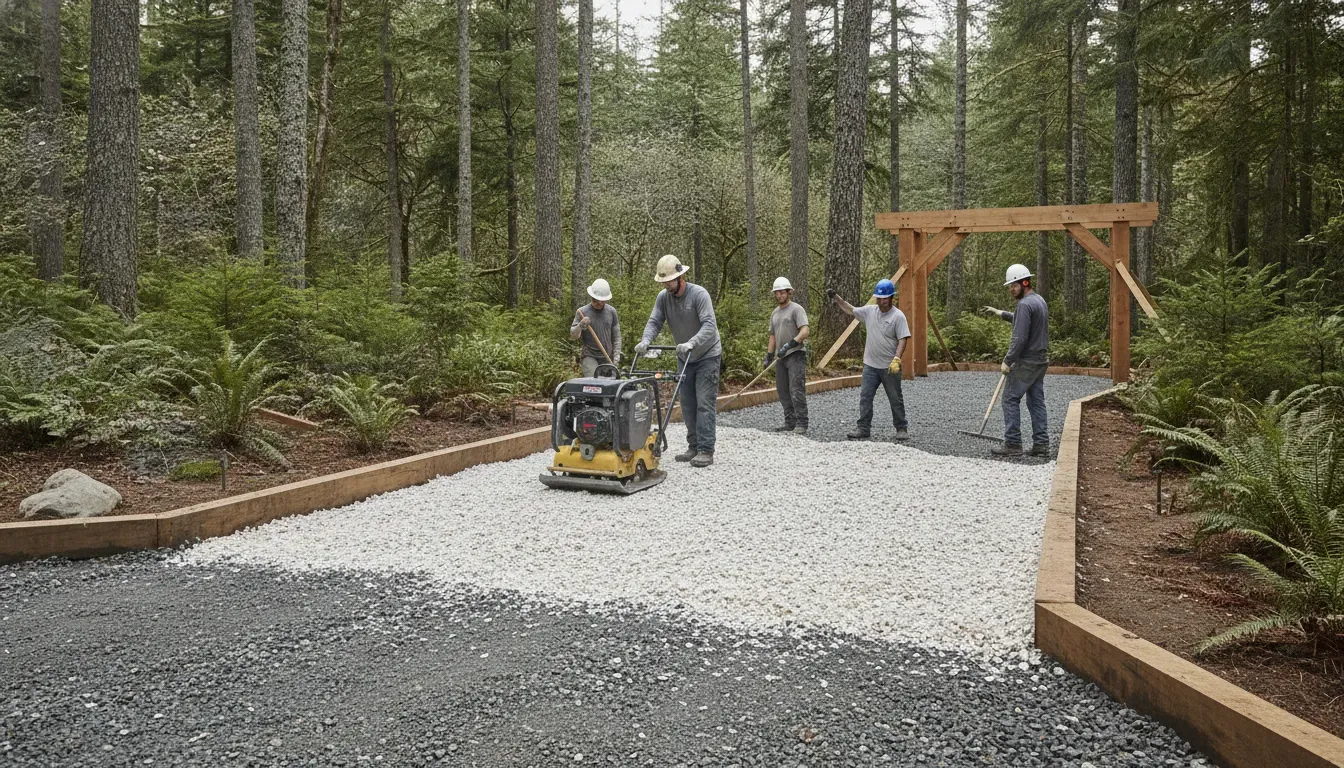
- Measure the area and study the site. Confirm the driveway footprint, vehicle movements, slopes, low spots, tie-ins, and access for delivery and equipment. Identify where stormwater should go before choosing the finished elevation.
- Prepare the subgrade. Remove unsuitable material and organic debris where required. A soft or saturated subgrade can undermine almost any aggregate surface, so the foundation must be addressed before the visible material is installed.
- Build and compact the base. Shellscapes recommends a gravel base layer for driveways and other higher-use applications. The base provides structure, helps establish drainage, and creates a more reliable platform for the crushed shell surface.
- Set the edges and transitions. Edging can separate the shell from planting beds, lawns, paving, or a garage apron. It also helps control migration at the locations where tires, plows, and runoff put the most pressure on the surface.
- Spread the crushed shell. The installer places the aggregate to the planned depth, taking the target coverage into account. For early estimating, one cubic yard covers about 100 square feet at 2 to 3 inches, but the final quantity depends on the design and site conditions.
- Compact with light water. Shellscapes’ guidance calls for light water spray during and after compaction. This helps shell flour move into the voids so the fragments can bind and begin to recalcify into a firm surface.
- Check drainage and finish levels. The finished driveway should shed or infiltrate water according to the site plan without directing runoff toward the home, garage, or neighboring property. The last check is as important as the first pass with the compactor.
Do not treat an oyster shell driveway as a material-only purchase when the site needs excavation, a new base, drainage correction, or substantial edging. Those preparation decisions affect both the installed cost and how the surface feels under daily traffic.
What Does an Oyster Shell Driveway Cost?
Short answer: There is no dependable universal price for an oyster shell driveway. A project quote should separate shell material, delivery, excavation, base work, grading, drainage, edging, labor, compaction, and any disposal or access challenges. Two driveways with the same square footage can have very different installed costs.
Shellscapes provides project-specific pricing rather than a one-size-fits-all driveway price. That approach is appropriate because the visible shell is only one part of the work. Before comparing a shell quote with a gravel quote, ask whether both include the same foundation, drainage, edge treatment, delivery, and finish expectations.
Main cost drivers
- Driveway area and depth: A larger footprint needs more aggregate, more delivery capacity, and more time to spread and compact. Depth should match the application and the prepared base, not an arbitrary material estimate.
- Subgrade condition: Removing soft soil, roots, old pavement, or failed aggregate can add preparation work before new material is placed.
- Base and drainage: A driveway that needs a new gravel base, grading, swales, drains, or other water-management work will cost more than a simple surface refresh.
- Delivery distance and access: Tight turns, steep grades, long carries, limited staging, and restricted equipment access can affect delivery and labor.
- Edging and transitions: Stone, timber, pavers, curbs, garage thresholds, and connections to walkways are separate design and construction decisions.
- Removal and disposal: Existing material may need to be removed, sorted, hauled away, or reused elsewhere on the property.
A simple planning calculation can establish a conversation without pretending to be a quote. A 600 square foot driveway divided by the approximate 100 square feet of coverage per cubic yard suggests about 6 cubic yards at a 2 to 3 inch depth. Actual ordering may change after the site, base, final grade, compaction, and expected settling are reviewed.
Contact Shellscapes for a site-specific driveway conversation and share the area, location, access conditions, and whether the project is new construction or a replacement.
Oyster Shell vs. Gravel: Which Surface Is Easier to Live With?
Short answer: Oyster shell is a strong choice when a homeowner wants a light, coastal surface with good drainage and a recycled material story, and is willing to invest in proper preparation. Gravel may be more familiar or readily available in some areas. The better surface is the one that matches the site’s traffic, drainage, appearance, maintenance, and supply requirements.
Both materials can fail when they are used to cover a poor foundation. Compare the complete installation, not just the price per load. Ask what happens at the driveway edge, how water will move during heavy rain, how the material connects to the street and garage, and what maintenance is expected after the first season.
| Question | When oyster shell may be the better fit | When gravel may be the better fit |
|---|---|---|
| What look do you want? | You want a bright, coastal surface that complements stone, timber, and planting | You prefer a darker or locally familiar aggregate color and texture |
| How important is the material story? | Recycled oyster shell and a regional grower partnership are meaningful to the project | Local quarry supply, conventional aggregate, or a familiar specification is the priority |
| What is the maintenance tolerance? | You prefer a compacted surface that can resist loose movement when installed correctly | You accept periodic raking, redistribution, and replenishment as part of driveway care |
| What does the site require? | The base, grade, drainage, and shell installation can be designed together | The local aggregate and base design are better suited to the traffic or site conditions |
Shellscapes also works on driveways as part of broader hardscape projects. If the driveway is part of a larger outdoor transformation, the company’s driveway construction service page can help frame the relationship between access, paths, patios, planting, and other site elements.
How Do Drainage and Maintenance Affect Performance?
Short answer: Crushed oyster shell drains well because it is porous, but porosity does not replace grading or a stable base. Plan where water travels, keep the driveway away from vulnerable building edges, inspect low areas after heavy rain, and address migration or settling early. Good maintenance protects the installation more than occasional cosmetic raking.
Drainage questions to answer first
- Does the driveway slope away from the house, garage, and other structures?
- Where will runoff go during a heavy Pacific Northwest rain?
- Is the subgrade capable of draining, or does it remain saturated?
- Will roof water, hillside flow, or street runoff cross the driveway?
- Do transitions to pavement, pavers, planting beds, or a public road need a specific edge or elevation?
The right answer may include grading, a base adjustment, an infiltration area, an edge drain, or another site-specific measure. Those choices should be made by the project team after reviewing the property, not inferred from the aggregate alone.
Routine maintenance
Inspect the surface after major rain, freeze-thaw cycles, or unusually heavy vehicle use. Sweep material back from planting beds and walkways, watch for low spots, and keep leaves and sediment from forming a compacted layer that changes how water moves. If a localized area settles or migrates, repair the cause before adding new material.
Properly installed crushed shell can become more cohesive as shell flour binds and the surface recalcifies. That does not mean the driveway is maintenance-free in every setting. Edges, transitions, drainage paths, snow equipment, and heavy turning movements still deserve periodic attention.
Is an Oyster Shell Driveway Right for Your Climate?
Short answer: Climate fit depends on water, temperature, traffic, and the local source of material. Oyster shell can work well in wet coastal landscapes when the base, grade, and drainage are designed for the site. In freeze-thaw or highly saturated conditions, the project needs closer attention to subgrade behavior, water movement, and seasonal maintenance.
For a Pacific Northwest property, wet winters and intense seasonal rainfall make the drainage conversation especially important. A shell surface can be attractive and permeable, but the entire driveway assembly still needs to handle water. Native planting, stone edging, timber, and carefully set grades can help the driveway feel integrated into the landscape rather than added on top of it.
Climate is not just a regional label. A steep wooded lot, a flat low area, a sunny exposed site, and a shaded driveway beside a garage may behave differently on the same street. Consider soil, slope, shade, vehicle load, delivery access, and how the driveway connects to the rest of the property.
Shellscapes’ design services can help homeowners coordinate materials, planting, circulation, and drainage before construction. See the Shellscapes landscape design packages if the driveway is one part of a larger property plan.
Explore Shellscapes’ crushed oyster shell supply options or request a quote after measuring the driveway and documenting access, grade, and drainage conditions.
Oyster Shell Driveway Questions
Can crushed oyster shell be used for a driveway?
Yes. Shellscapes lists driveways among the applications for its crushed oyster shell aggregate. Driveways need careful subgrade evaluation, a stable base, drainage planning, consistent spreading, and compaction. The visible shell layer should be designed as part of a complete driveway assembly rather than installed directly over uncertain soil.
How much area does one cubic yard cover?
Shellscapes’ current planning specification is about 100 square feet per cubic yard at a 2 to 3 inch depth. Coverage changes with the finished depth, the base, the driveway shape, compaction, and site-specific allowances. Treat the figure as an estimating starting point, not a final order quantity.
Is an oyster shell driveway cheaper than gravel?
There is no universal answer. Compare delivered material, base preparation, excavation, drainage, edging, labor, compaction, and long-term maintenance for both options. Shellscapes prices material and project work according to the site, so a project-specific quote is more useful than an unsupported per-square-foot number.
Does an oyster shell driveway need a gravel base?
Shellscapes recommends a gravel base layer for driveways and other higher-use applications. The correct base depth and construction depend on the subgrade, drainage, traffic, and finished elevations. A contractor should confirm the assembly after reviewing the property rather than treating one depth as appropriate for every driveway.
Will crushed oyster shell wash away in the rain?
A properly graded and compacted driveway should be planned to manage water, but no loose aggregate surface is immune to runoff problems. Drainage, slopes, edges, and low spots matter. If water crosses the driveway or concentrates at an edge, address that flow before adding more shell.
Plan the Driveway Around the Site
An oyster shell driveway can combine a bright coastal appearance, a recycled material story, useful permeability, and a firm compacted surface. Its success depends on the less visible decisions: subgrade, base, drainage, edge control, delivery, compaction, and maintenance expectations.
Talk with Shellscapes about an oyster shell driveway plan and provide the site area, intended traffic, location, photos, and any known drainage concerns.